Predictive Intelligence

Catch failing equipment weeks early. Works on the plant data you already collect, with wireless sensors where it can't reach.

Machines warn you. Usually nobody is listening.

Long before it quits, a machine draws more current, runs hotter, and shakes differently. Control Seat watches all of it and names the fault, instead of telling you a number moved.

  • Rotating: worn bearings, unbalance, misalignment, looseness, gear wear, cavitation.
  • Fluid: pumps and fans losing output, clogged filters, fouled heat exchangers, sticking valves, leaks.
  • Electrical: motors drawing power differently, unbalanced phases, panels and transformers running hot.
  • In detail: the full vibration spectrum on three axes plus ultrasound, not one summary number.
  • In context: every finding weighed against load, speed, and temperature.
VIBRATION SPECTRUMEvery part of a machine shakes at its own rate.HOW HARD IT SHAKESlowhigh frequencyrunning speedRotor unbalanceNormal rangeTodayAbove normal

Two ways in. You don't have to pick.

Most condition monitoring tells you nothing until hardware is on every asset. Start with readings you already collect, with our sensors, or with both.

  • Your data: connect a historian, SCADA, or PLC. Load, power, temperature, pressure, flow, and speed become the inputs.
  • What that finds on its own: efficiency drift, heat, pumps and fans losing output, clogged filters, slowing cycles, sticking valves.
  • Where sensors are needed: bearings, gears, and lubrication only show up in high-frequency vibration and ultrasound. A historian never samples that fast.
  • Together: sensor readings get weighed against load and speed, so a hard week stops looking like a fault.
DATA YOU ALREADY HAVEHistorianSCADAPLC tagsSENSORS WHERE NEEDEDPump 1Motor 3GatewayControl Seat tags

The sensors we put on machines.

Vibration and ultrasound for rotating equipment, pressure and flow for fluid systems, current and temperature for electrical gear. One receiver on your gateway finds every sensor on the mesh. We mount them and map the tags, then each machine learns its own normal. No thresholds to guess. No proprietary cloud.

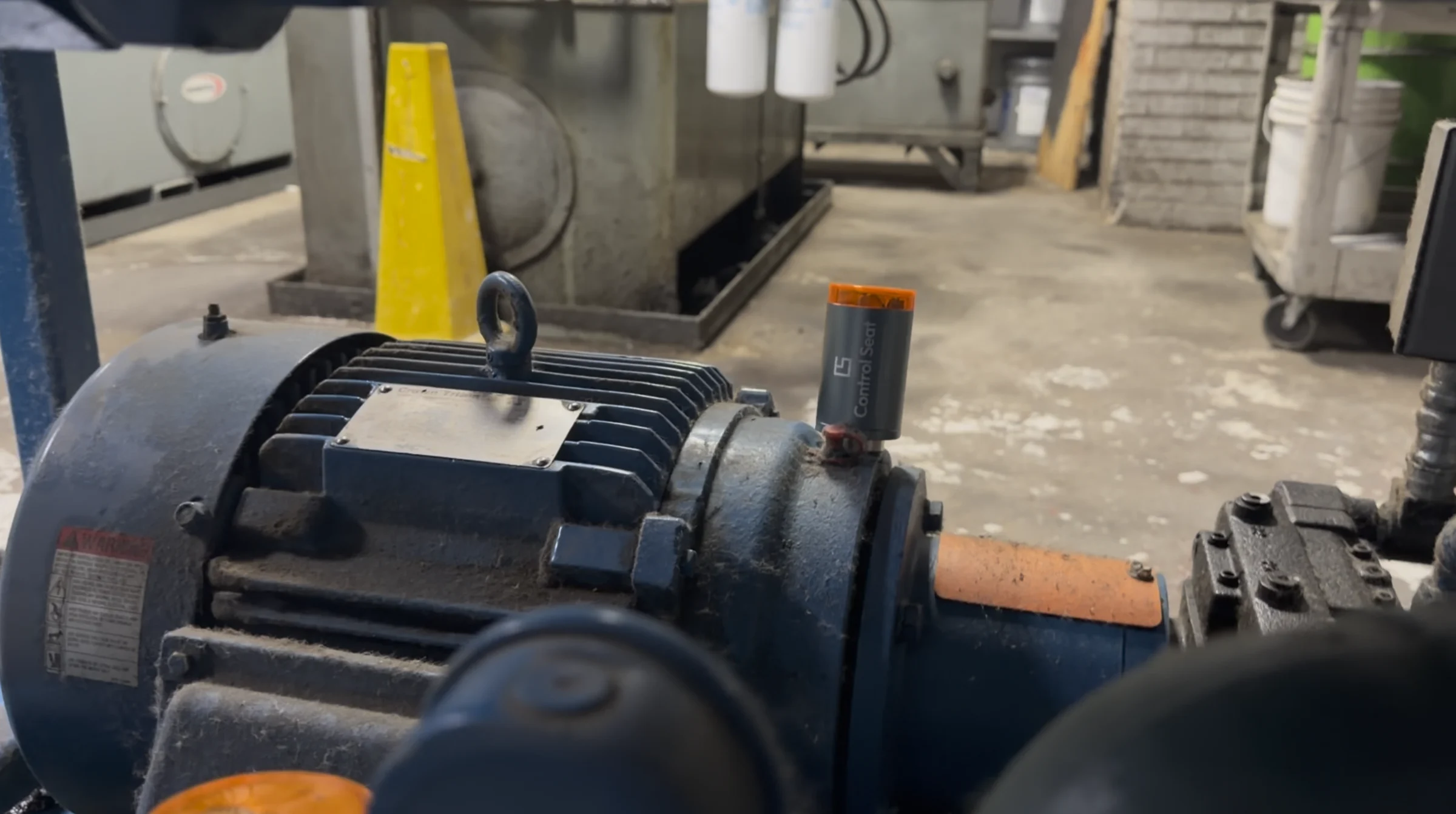
Wireless condition monitoring sensor

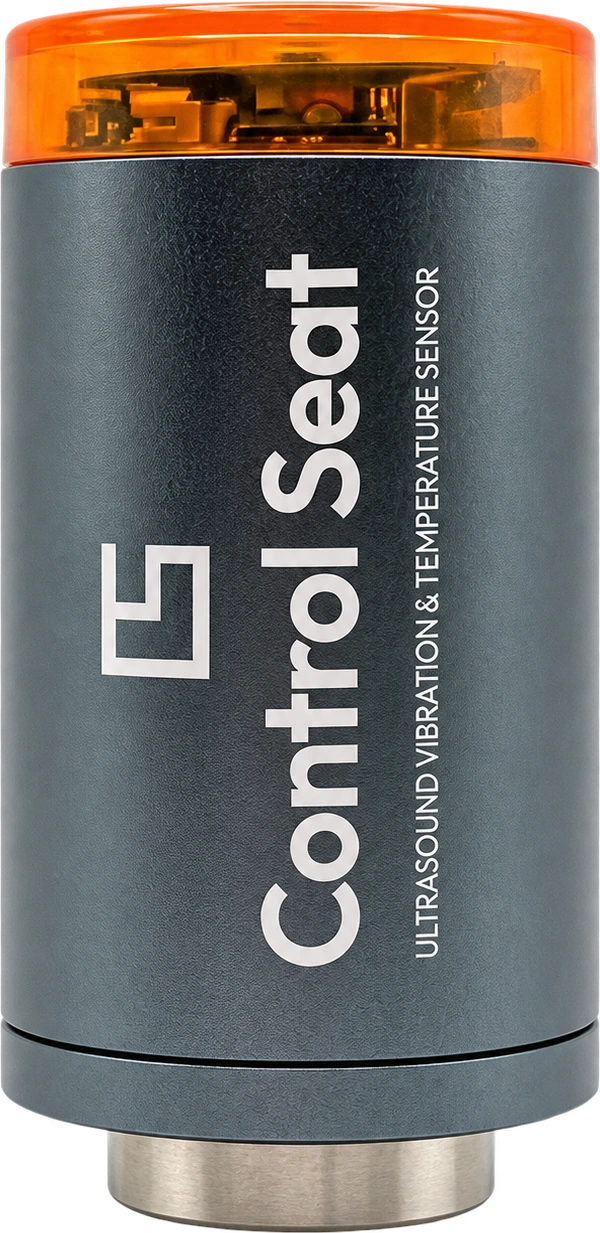
Control Seat Vibration, Ultrasound & Temperature

A sealed puck that magnets onto the machine and reports vibration, ultrasound, temperature, RPM, and runtime.

Configured by Control SeatMesh commissioning and tag mapping

We pair each sensor and map its readings into your workspace as tags. Each machine then learns its own normal from how it actually runs.

Vibration sensor specification

Measurements
3-axis vibration · ultrasound · temperature · RPM · asset runtime
Vibration range
±16 g or ±64 g full scale · configurable 200 Hz to 25.6 kHz sample rate
Vibration output
Acceleration · velocity · displacement · peak frequency · time-domain data for FFT
Ultrasound
30 dBuV to 120 dBuV · sample rate up to 82 kHz
Time-domain capture
Up to 8,100 samples per axis
Wireless
900 MHz / 868 MHz self-healing mesh · up to 2 miles line of sight, 1,000 ft indoors
Battery
Hybrid D-cell lithium and supercapacitor · up to 5 years · field replaceable
Environmental
IP67 · aluminum housing · 84 mm x 50 mm
Mounting
Magnetic or 1/4 in. 28 UNF stud
On board
Machine learning for anomaly detection and power management · OTA firmware and config

Included with every deployment

  • Control Seat wireless vibration, ultrasound, and temperature sensor
  • Magnetic mount and 1/4 in. 28 UNF stud adapter
  • Hybrid D-cell lithium battery and supercapacitor, installed
  • Mesh network commissioning onto your gateway
  • Tag mapping into your Control Seat workspace
  • Automatic baselining, with no thresholds to configure

Range figures are for 900 / 868 MHz mesh. The 2.4 GHz option reaches about 1 mile line of sight, 300 ft indoors. Battery life depends on sample rate and raw capture.

Sensor count, gateway placement, and lead time are confirmed with each quote.

A spectrum nobody can read never prevented a failure.

  1. Connect what you already run

    Point Control Seat at your SCADA, historian, or PLCs. It reads tags, alarms, and history. It never writes back.

  2. Add sensors where you need them

    Where the tags can't show a fault, we mount one. Vibration, ultrasound, pressure, flow, current, temperature.

  3. Learn the machine in context

    Each machine learns its own normal from how it actually runs. Working harder stops looking like wearing out.

  4. Get findings you can check

    Every finding names the fault, rates how urgent it is, and shows the evidence behind it.

We connect to:

Fix it on your schedule.

Equipment degrades for weeks before it stops. Enough time to order the part and book the crew, instead of paying for an emergency callout.

OVERALL VIBRATIONalert levelCaught herebaselineweeks laterWeeks of warning, not minutes

Start with the machines that keep stopping.

Tell us which assets cause the most downtime. We'll show you what Control Seat would watch, and what it takes to connect.

Talk to us
Request a demo